
GeoDNS | Geographic DNS Response Intelligence
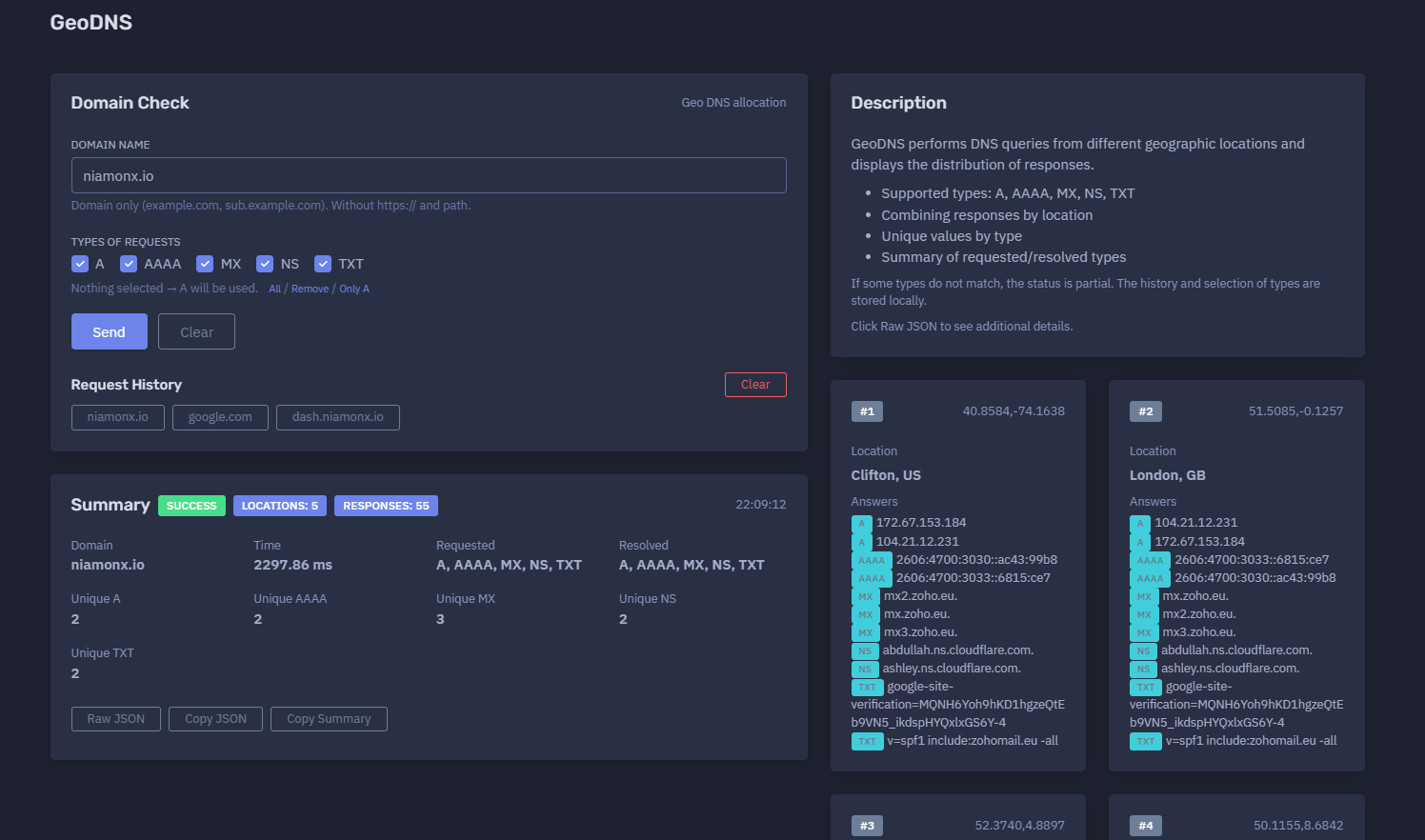
The platform available at https://dash.niamonx.io/geodns — known as GeoDNS — is a multi-location DNS intelligence tool within the NiamonX platform. It allows users to query DNS records for a domain from several geographic locations and compare how responses differ across regions.
Overview of the Service
GeoDNS is designed to help users understand how a domain resolves from different parts of the world.
Unlike a standard DNS lookup, which checks records from a single resolver or location, GeoDNS performs DNS queries from multiple geographic test points. This makes it possible to detect regional DNS differences, CDN routing behavior, GeoDNS configuration, DNS propagation issues, resolver inconsistencies, and location-based infrastructure allocation.
The tool supports common DNS record types, including:
-
A
-
AAAA
-
MX
-
NS
-
TXT
GeoDNS is useful for system administrators, DevOps teams, SOC analysts, cybersecurity researchers, infrastructure owners, domain administrators, compliance teams, and OSINT analysts who need to verify DNS behavior across multiple regions.
🔍 How the Tool Works
When a user enters a domain name and selects DNS record types, GeoDNS sends DNS queries from multiple geographic locations.
Each location performs the selected DNS requests and returns the records visible from that region. The tool then aggregates all responses and displays:
-
Global query status
-
Number of test locations
-
Total number of DNS responses
-
Total request time
-
Requested record types
-
Resolved record types
-
Unique values by record type
-
Per-location answers
-
Geographic source coordinates
-
Raw JSON with additional technical details
If no record type is selected, the tool automatically uses A records.
Example flow:
-
User enters a domain.
-
User selects one or more DNS record types.
-
GeoDNS queries the domain from several locations.
-
Responses are grouped by geographic source.
-
Unique DNS values are counted by type.
-
The final report shows global and regional DNS behavior.
🧩 What Can Be Checked
GeoDNS accepts clean domain and subdomain names only.
Valid examples:
example.com
sub.example.com
niamonx.io
Invalid examples:
https://example.com
example.com/path
https://example.com/login
1.1.1.1
The tool is intended for DNS checks of domains and subdomains. It should not be used with URLs, protocols, paths, query strings, IP addresses, or ports.
⚙️ Query Interface
The GeoDNS interface contains a domain input field and DNS record type controls.
Domain Name
The user enters a clean domain or subdomain.
Example:
niamonx.io
The interface expects the domain only, without:
-
https:// -
http:// -
Slashes
-
Paths
-
URL parameters
-
Ports
Types of Requests
Users can select one or more DNS record types.
Supported types:
-
A
-
AAAA
-
MX
-
NS
-
TXT
Quick controls may include:
-
All
-
Remove
-
Only A
If nothing is selected, the system automatically uses type A.
📌 Supported DNS Record Types
A Records
An A record maps a domain to an IPv4 address.
Example:
A 172.67.153.184
A records are commonly used for websites, APIs, CDNs, proxies, and IPv4 infrastructure.
AAAA Records
An AAAA record maps a domain to an IPv6 address.
Example:
AAAA 2606:4700:3033::6815:ce7
AAAA records are used for IPv6-enabled services.
MX Records
An MX record identifies mail servers responsible for receiving email for the domain.
Example:
MX mx.zoho.eu.
MX records are important for mail routing, email delivery, and mail-provider verification.
NS Records
An NS record identifies authoritative name servers for the domain.
Example:
NS abdullah.ns.cloudflare.com.
NS records show which DNS provider or authoritative DNS infrastructure controls the zone.
TXT Records
A TXT record stores text-based DNS data.
Common TXT record uses include:
-
SPF
-
DKIM
-
DMARC
-
Domain ownership verification
-
Google / Microsoft / SaaS verification
-
Security policies
-
Service configuration
Example:
TXT v=spf1 include:zohomail.eu -all
TXT records are often important for domain security and compliance checks.
📊 Summary Section
After a successful query, GeoDNS displays a global summary.
Typical fields include:
| Field | Description |
|---|---|
| Status | Overall query result status |
| Locations | Number of geographic locations used |
| Responses | Total number of returned DNS answers |
| Domain | Queried domain |
| Time | Total request duration |
| Requested | Record types requested by the user |
| Resolved | Record types successfully returned |
| Unique A | Number of unique IPv4 answers |
| Unique AAAA | Number of unique IPv6 answers |
| Unique MX | Number of unique mail server answers |
| Unique NS | Number of unique name server answers |
| Unique TXT | Number of unique TXT answers |
Example summary:
SUCCESS
Locations: 5
Responses: 55
Domain: niamonx.io
Time: 2297.86 ms
Requested: A, AAAA, MX, NS, TXT
Resolved: A, AAAA, MX, NS, TXT
Unique A: 2
Unique AAAA: 2
Unique MX: 3
Unique NS: 2
Unique TXT: 2
This summary helps users quickly understand whether DNS records are consistent globally and how many unique values were observed.
🌍 Per-Location Results
GeoDNS displays DNS answers separately for each test location.
Each location block may include:
-
Location number
-
Coordinates
-
City and country
-
Returned DNS answers
-
Record types returned from that location
Example location block:
#1
Location: Clifton, US
Coordinates: 40.8584, -74.1638
Answers:
A 172.67.153.184
A 104.21.12.231
AAAA 2606:4700:3030::ac43:99b8
MX mx.zoho.eu.
NS abdullah.ns.cloudflare.com.
TXT v=spf1 include:zohomail.eu -all
Per-location results are the core value of GeoDNS. They allow analysts to compare regional DNS behavior instead of relying on a single resolver response.
🗺️ Geographic Test Locations
GeoDNS uses multiple geographic sources for DNS resolution.
Example locations may include:
-
Clifton, US
-
London, GB
-
Amsterdam, NL
-
Frankfurt am Main, DE
-
Singapore, SG
Each location can return the same or different DNS answers depending on the domain’s DNS configuration, CDN provider, resolver behavior, cache state, or regional routing policy.
Geographic DNS results are especially useful for domains using:
-
CDN providers
-
Anycast DNS
-
GeoDNS
-
Regional load balancing
-
Multi-region infrastructure
-
Split traffic routing
-
Regional failover
-
DNS-based traffic steering
🔁 Requested vs Resolved Types
GeoDNS clearly shows which record types were requested and which were actually resolved.
Example:
Requested: A, AAAA, MX, NS, TXT
Resolved: A, AAAA, MX, NS, TXT
If some requested types do not return answers, the status may be partial.
Example:
Requested: A, AAAA, MX, NS, TXT
Resolved: A, NS, TXT
Status: partial
This helps analysts quickly identify missing or unavailable DNS records.
⚠️ Partial Status
If some selected record types do not match or do not return from all locations, the query may be marked as partial.
A partial result may indicate:
-
The domain does not have that record type.
-
Some resolvers did not return the record.
-
DNS propagation is incomplete.
-
A regional resolver returned different results.
-
A record type is blocked or filtered.
-
The backend source returned incomplete data.
-
The domain configuration is inconsistent.
A partial status is not always an error. It means the user should review the per-location answers and resolved types carefully.
🧮 Unique Values by Type
GeoDNS calculates unique DNS answers by record type.
Example:
Unique A: 2
Unique AAAA: 2
Unique MX: 3
Unique NS: 2
Unique TXT: 2
This is useful for identifying whether all locations returned the same values or whether responses vary geographically.
Low Unique Count
A low unique count usually means the DNS response is consistent globally.
High Unique Count
A high unique count may indicate:
-
GeoDNS routing
-
CDN edge allocation
-
Regional load balancing
-
DNS failover
-
Multi-cloud infrastructure
-
Inconsistent DNS propagation
-
Resolver differences
🌐 GeoDNS and CDN Behavior
Many modern domains use CDNs or geographically distributed DNS infrastructure. GeoDNS helps detect this behavior.
Possible patterns:
Same Records Everywhere
If all locations return the same A and AAAA values, the domain likely has globally consistent DNS responses.
Different A / AAAA Records by Region
If locations return different IPs, the domain may use GeoDNS, CDN edge routing, regional load balancing, or DNS steering.
Same MX / NS Everywhere
TXT Differences
TXT records are usually consistent, but differences may indicate propagation delay, configuration drift, or resolver cache differences.
📬 Mail and Security Record Review
GeoDNS can be used to check whether mail and security-related DNS records are globally visible.
Important record types:
-
MX
-
TXT
-
NS
Common TXT checks:
-
SPF
-
DKIM
-
DMARC
-
Domain verification
-
SaaS verification
Example SPF record:
v=spf1 include:zohomail.eu -all
To check DMARC, users should query:
_dmarc.example.com
To check DKIM, users should query the specific selector subdomain, such as:
selector._domainkey.example.com
📦 Raw JSON
The tool can show Raw JSON with additional technical details.
Raw JSON may include:
-
Location metadata
-
Resolver details
-
Record values
-
Record types
-
Response timing
-
Internal status fields
-
Backend diagnostics
-
Full per-location response objects
Raw JSON is useful for:
-
Advanced troubleshooting
-
Developer analysis
-
SOC workflows
-
API-style evidence capture
-
Comparing normalized and raw results
-
Creating internal reports
-
Debugging inconsistent DNS behavior
Raw output should be handled carefully when it contains internal investigation details.
🕓 Request History
GeoDNS stores domain query history and selected record types locally in the browser.
The history may include:
-
Queried domain
-
Selected record types
-
Timestamp
-
Status
-
Response count
-
Location count
Local history helps users repeat previous checks quickly.
Because it is browser-local, it may be cleared when browser data is deleted or when another browser profile is used.
🧠 Key Features
Multi-Location DNS Queries
Runs DNS checks from several geographic locations.
Domain and Subdomain Support
Accepts clean domain and subdomain names.
Common DNS Record Types
Supports A, AAAA, MX, NS, and TXT.
Automatic A Fallback
If no type is selected, A is used automatically.
Regional Response Comparison
Displays DNS answers separately by location.
Unique Value Aggregation
Counts unique DNS responses per record type.
Requested and Resolved Summary
Shows what was requested and what was returned.
Partial Status Detection
Highlights cases where not all requested types were resolved.
Raw JSON View
Allows technical review of additional response details.
Local History
Stores query history and selected types locally in the browser.
✅ Recommended Analyst Workflow
A practical GeoDNS workflow should follow these steps.
1. Enter a Clean Domain
Use only a domain or subdomain. Do not include protocol, path, or URL parameters.
2. Select Record Types
Choose A, AAAA, MX, NS, TXT, or use All for a broad overview.
3. Review the Summary
Check status, locations, responses, requested types, resolved types, and unique counts.
4. Compare Locations
Look for differences between Clifton, London, Amsterdam, Frankfurt, Singapore, or other returned locations.
5. Review Unique Values
Check whether unique A / AAAA values differ across regions.
6. Validate Mail Records
Review MX and TXT records for mail and verification consistency.
7. Investigate Partial Results
If status is partial, check which locations or record types did not return expected results.
8. Use Raw JSON When Needed
Open Raw JSON for deeper diagnostics.
9. Repeat After DNS Changes
Run another check after DNS updates, migrations, or propagation windows.
10. Confirm Critical Issues
🔎 Common Use Cases
GeoDNS supports many technical workflows.
DNS Propagation Check
Verify whether DNS updates are visible from multiple locations.
CDN Validation
Check whether a CDN returns different IPs by region.
GeoDNS Testing
Confirm location-based DNS allocation.
Mail Configuration Review
Check MX and TXT record consistency globally.
Domain Migration Validation
Verify that records changed correctly after moving DNS providers or hosting.
Incident Response
Investigate DNS hijacking, unexpected records, or inconsistent resolver behavior.
SOC and OSINT Enrichment
Collect regional DNS evidence for suspicious domains.
Infrastructure Monitoring
Track whether critical DNS records remain stable across locations.
⚠️ Result Interpretation Notes
GeoDNS results should be interpreted carefully.
Important points:
-
DNS responses may vary by location.
-
Different answers are not always suspicious.
-
CDN and GeoDNS providers intentionally return regional answers.
-
Resolver cache may affect results.
-
DNS propagation can take time.
-
TXT record order may vary between responses.
-
MX record order may vary while representing the same configuration.
-
Partial status may mean records are missing, filtered, delayed, or simply not configured.
-
One test is a snapshot, not continuous monitoring.
For production DNS decisions, compare GeoDNS results with authoritative DNS checks and monitoring tools.
🛡️ Security, Privacy & Responsible Use
GeoDNS is intended for lawful DNS troubleshooting, infrastructure analysis, security review, OSINT enrichment, and domain administration.
Acceptable use cases include:
-
Checking your own domains
-
Validating DNS propagation
-
Reviewing CDN behavior
-
Investigating suspicious domains
-
Checking mail configuration
-
Reviewing SPF, DKIM, DMARC, MX, and NS visibility
-
Supporting SOC triage
-
Documenting DNS infrastructure
-
Monitoring regional DNS behavior
Users should follow responsible use principles:
-
Do not use DNS intelligence for phishing or impersonation.
-
Do not target third-party infrastructure based only on DNS results.
-
Validate suspicious findings with additional sources.
-
Treat lookup history as potentially sensitive on shared devices.
-
Use Raw JSON responsibly.
-
Use the tool only for lawful and ethical analysis.
⚙️ Technical Highlights
-
GeoDNS intelligence module
-
Available at
dash.niamonx.io/geodns -
Performs DNS queries from multiple geographic locations
-
Supports domain and subdomain input
-
Rejects protocols, paths, and full URLs
-
Supports A records
-
Supports AAAA records
-
Supports MX records
-
Supports NS records
-
Supports TXT records
-
Uses A automatically when no type is selected
-
Shows global query status
-
Shows number of locations
-
Shows total response count
-
Shows total request time
-
Shows requested record types
-
Shows resolved record types
-
Counts unique records by type
-
Displays answers per location
-
Shows location coordinates
-
Supports Raw JSON details
-
Stores query history locally
-
Stores selected record types locally
-
Suitable for DNS propagation checks, CDN validation, SOC workflows, OSINT, and infrastructure monitoring
📌 Usage Hints
-
Enter only a domain or subdomain.
-
Do not include
https://, paths, query strings, or slashes. -
Select A for IPv4 address records.
-
Select AAAA for IPv6 address records.
-
Select MX for mail routing.
-
Select NS for authoritative name servers.
-
Select TXT for SPF, verification, and security records.
-
Use All for a complete basic DNS overview.
-
If nothing is selected, A will be used automatically.
-
Compare answers by location to detect GeoDNS behavior.
-
Check unique values to understand regional differences.
-
Use Raw JSON for deeper diagnostics.
-
Query
_dmarc.example.comseparately for DMARC. -
Query DKIM selector subdomains separately for DKIM.
-
Remember that DNS results can differ because of cache, CDN, resolver, or propagation behavior.
📬 Contact Information
For technical, legal, abuse, privacy, or support-related inquiries, users can contact the NiamonX team directly:
support@niamonx.io — Technical Support
other@niamonx.io — General Inquiries
takedown@niamonx.io — Privacy or Data Removal Requests
legal@niamonx.io — Legal and Compliance Matters
Alternative contact channel:
🔗 Helpdesk: https://support.niamonx.io/
Summary
NiamonX GeoDNS is a multi-location DNS intelligence tool that checks DNS records from several geographic locations and shows how domain responses are distributed globally.
It supports A, AAAA, MX, NS, and TXT queries, displays requested and resolved record types, counts unique values by type, groups answers by location, provides Raw JSON for deeper analysis, and stores query history locally in the browser.
The tool is designed for DNS propagation checks, GeoDNS validation, CDN behavior analysis, mail configuration review, SOC triage, OSINT enrichment, domain migration validation, and infrastructure monitoring.